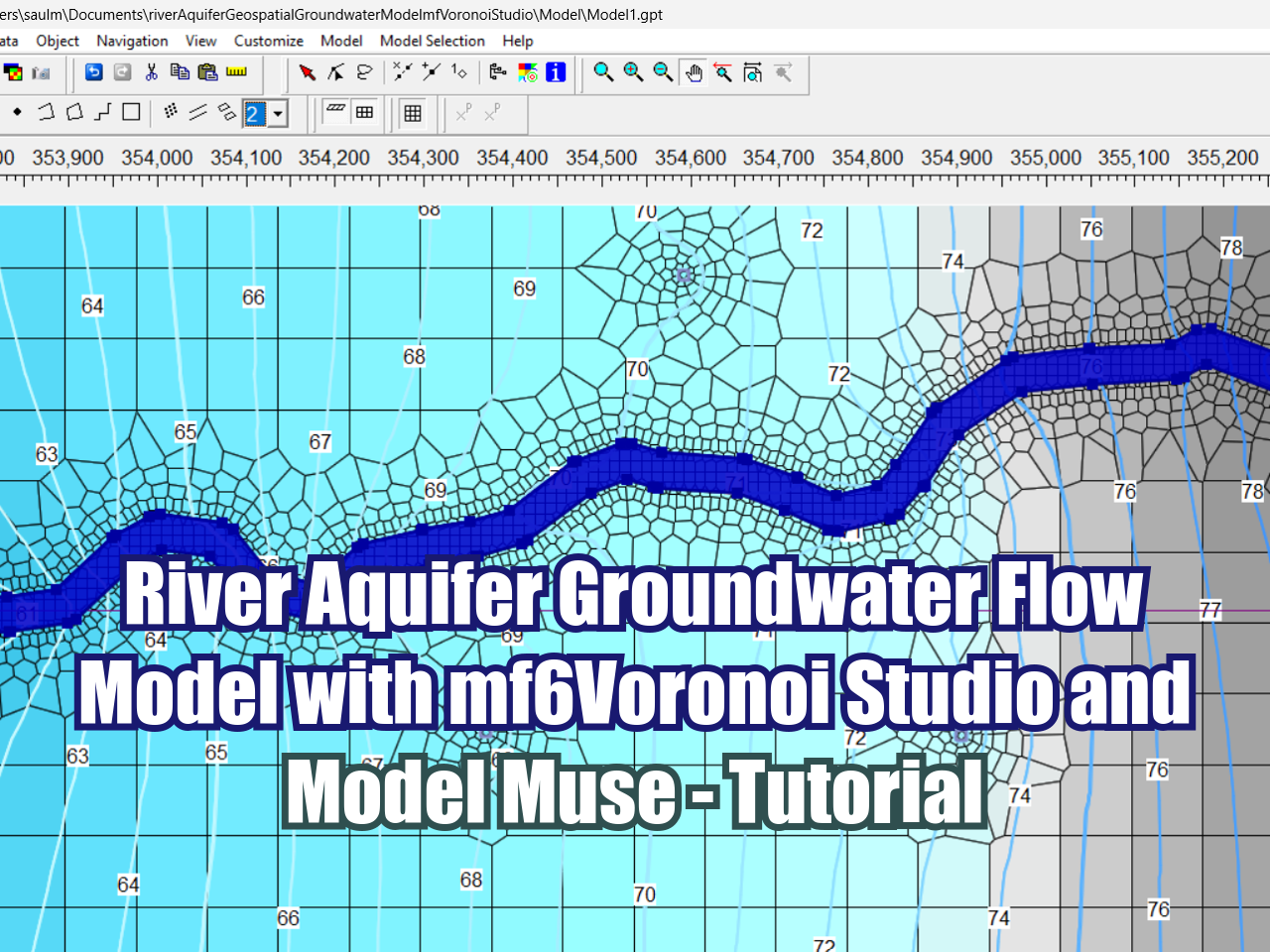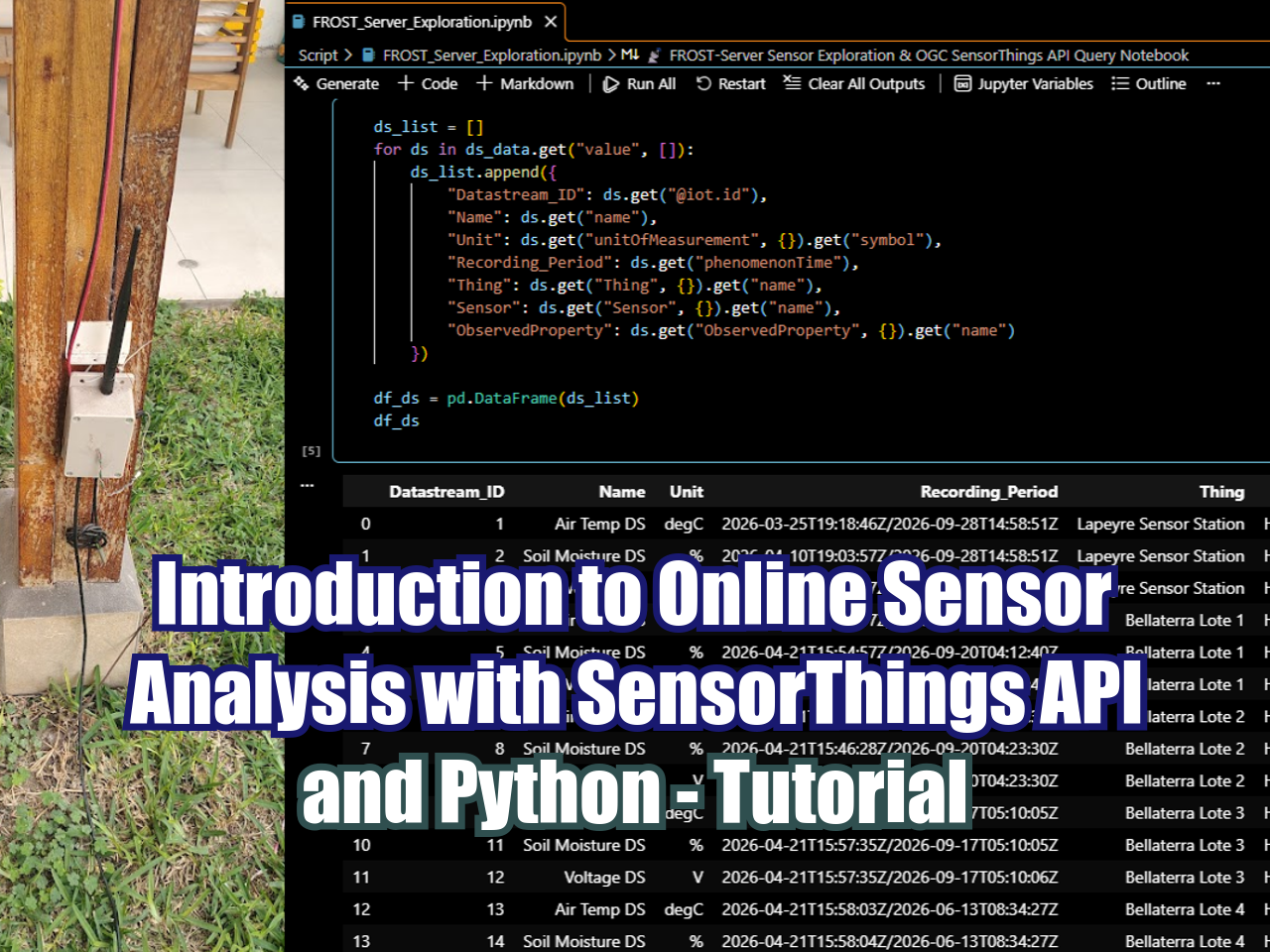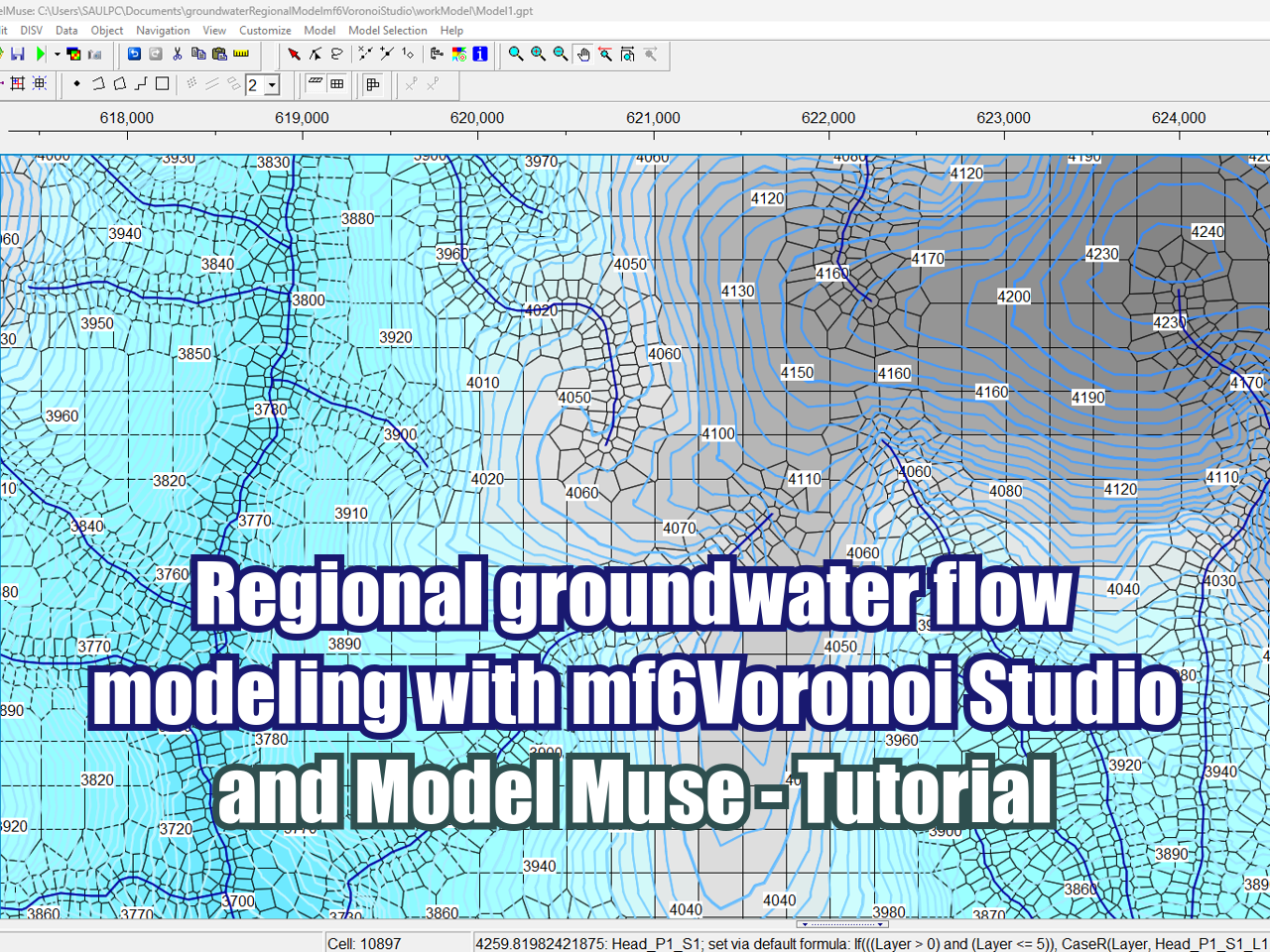
River Aquifer Groundwater Flow Model with mf6Voronoi Studio and Model Muse - Tutorial

This tutorial demonstrates how to build and simulate a groundwater model focused on river-aquifer interactions using open-source software. The workflow begins in mf6Voronoi Studio, where a Voronoi grid mesh is generated to capture complex spatial geometries efficiently. The mesh is then imported into ModelMuse, where key aquifer properties and essential boundary conditions—including general head, river, well, recharge, and evapotranspiration—are configured. After running the model, the simulated results are evaluated through an analysis of the water balance and head distribution.

Read More
Benchmarking mf6Voronoi v0.0.38: Parallel Performance, Scaling Limits, and Mesh Refinement Dynamics

With the upcoming release of mf6Voronoi v0.0.38, optimizing mesh generation workflows remains a top priority. Constructing complex unstructured Voronoi grids for MODFLOW 6 can become computationally intensive as spatial resolution increases. To address this challenge, parallel execution capabilities were introduced into mf6Voronoi leveraging dask-geopandas.

Read More

Automatic calibration of pumping test data with MODFLOW6, Model Muse and Pest - Tutorial

This tutorial walks hydrogeologists through the full workflow of automatic calibration of pumping test data using MODFLOW 6, ModelMuse, and PEST. A real pumping test scenario — comprising a 6-hour pumping phase and an 18-hour recovery phase — is set up in ModelMuse, where the well is conceptualized as a Multinode Aquifer Well (MAW) boundary condition to accurately represent multilayer aquifer interactions. PEST is then implemented to automatically estimate key hydraulic parameters including hydraulic conductivity, specific storage, and specific yield, eliminating tedious manual calibration and delivering reproducible, optimized results. Whether you're new to parameter estimation or looking to streamline your existing workflow, this tutorial offers a practical, hands-on guide to modern groundwater model calibration.

Read More

Regional example of seawater intrusion modeling with MODFLOW6 and mf6Voronoi - Tutorial

This is an applied example of seawater intrusion modeling using MODFLOW6 and the BUY package. The model is fully geospatial and works with ESRI Shapefiles and rasters (*.tif) as inputs. The model grid is based on Voronoi meshes generated with the Python package mf6Voronoi. Since there are so many concepts involved in the conceptualization of a variable density groundwater flow simulation with MODFLOW6 and Flopy, these cases use a code template from mf6Voronoi that simplifies the model construction and simulation. The applied case also gives us the chance to discuss the main parts of model setup.

Read More

How to import and simulate a MODFLOW6 with Voronoi mesh model into Model Muse - Tutorial

Did you know that you can import a Voronoi mesh MODFLOW 6 model created with mf6Voronoi into Model Muse. And you can not only import it, but also apply boundary conditions, solver parameters, review datasets, and simulate groundwater flow.

This tutorial shows a complete applied case for the import of the geometry and hydraulic parameters created with mf6Voronoi into Model Muse. The model is set up with boundary conditions, and simulated with different solver parameters.

Read More

Simple example of construction site drainage modeling with MODFLOW6 and mf6Voronoi - Tutorial

In mf6Voronoi horizontal flow barriers can be modeled as low k cells with thickness of 1m without compromising the cell amount and model performance. We have developed an applied case of construction site dewatering using horizontal drains and pumping wells that work in parallel over a period of 8 days. The model shows the performance of the drainage schema and exports the final water table as raster and contours.

Read More

Simple example of seawater intrusion modeling with MODFLOW6 and mf6Voronoi - Tutorial

We wanted to present seawater intrusion modeling in its more primitive form, on a simple aquifer conceptualization and aquifer geometry where the user can focus on the code implementation with MODFLOW6 - Buy package, Flopy and mf6Voronoi. We have also developed a precoded template for seawater intrusion that allows users to reduce time.

Read More

7 tutorials for coupling geological information into groundwater flow models build with Model Muse

Next challenges on groundwater modeling facing scenarios of climate change and sustainable groundwater management require the implementation of fully coupled geological models into groundwater flow models. Even though we have dealt with this topic, we still have a lot to do in providing applied cases / tutorials for the hydrogeological unit conceptualization based on geological information with open source codes such as MODFLOW.

Read More

Groundwater seepage from a water reservoir modeling with Modflow6 and mf6Voronoi - Tutorial

Applied case of local groundwater modeling based on a regional groundwater flow to evaluate the interaction of the water reservoir with the groundwater flow system and the seepage rate from the reservoir. The model runs on steady state and shows the procedure to modify original/final surfaces without error on layer thickness.

Read More

7 tutorials of MODFLOW6 and mf6Voronoi for mine related groundwater modeling

Mining hydrogeology is one of the most challenging faces of hydrogeology since its evaluations are key components for the mine operation and where groundwater related decisions are needed on a short timeframe. We have developed a series of tutorials that will introduce general groundwater modelers to the specific tasks of mine hydrogeology. This tutorial selection starts from regional modeling and goes into inflow and contaminant transport with different levels of complexity.

Read More

Groundwater inflows to open pit modeling with faults of 1m using MODFLOW6 and mf6Voronoi - Tutorial

Applied example of the simulation of groundwater inflow to a open pit considering faults of 1 meter thickness. The model has 6 stress period, one steady state and 5 transient stress periods representing the pit development over 4 years of a total mine life of 20 years. The tutorial shows the complete process beginning from mesh creation, model construction, water budget analysis and 3d representation.

Read More

Inflow modeling to infiltration galleries with MODFLOW6 and mf6Voronoi - Tutorial

Infiltration galleries are a low cost and low maintenance option for domestic water supply. The amount of inflow water and the interaction with the water bodies are main concerns on the evaluation and design of infiltration galleries. We have done an applied case of inflow simulation to infiltration galleries with MODFLOW6 based on Voronoi meshes. The example covers all steps from mesh creation, steady state model construction, simulation of infiltration galleries and the inflow calculation per gallery group. Finally a 3D representation of the model geometry, boundary conditions and head distribution is performed on Paraview.

Read More

How to create a Geospatial Raster from a projected Reservoir with Python and hatariTools - Tutorial

The task to modify geospatial rasters considering future elements can be a complex task with the available GIS tools. We have optimized the way we can represent the surface of future (or current) water reservoirs on a fully geospatial raster. This tutorial shows the complete process to create a geospatial raster (TIF file) based on the contours from the dam and the reservoir extension.

Read More

Contaminant Plume from a Tailings Storage Facility Modeling with MODFLOW6 and mf6Voronoi - Tutorial

MODFLOW6 with mf6Voronoi can handle the simulation of specific tasks related to the mine industry. We have already covered the simulation of pit inflows with Voronoi meshes and now we are going to model the seepage from a tailings storage facility. The applied case covers all steps from mesh construction, flow model and transport model. Results are plotted on 2d and exported to 3d in Vtk format.

Read More

Developing a regional groundwater model for a mine project with MODFLOW6 and mf6Voronoi - Tutorial

Sometimes regional models are required as an input for local models of flow and transport. This is an applied case of the groundwater modeling on the regional scale in the state of Guerrero, Mexico that will be the input for future local models of pit dewatering, and contaminant transport from the tailings dam and waste dump. The groundwater model is built with MODFLOW6 and mf6Voronoi on a series of Jupyter Notebooks and results are plotted with Paraview.

Read More